Saturday, February 7, 2015

Early Christian


The Early Christian time period began with the death of Christ in Judea, which was an outpost of the Roman empire. Rome did not like that Christians refused to declare the divinity of the Emperor, so many Christians were persecuted. This meant that Christianity essentially became on underground religion, mostly observed by the lower class. Since Christians had to hide their faith they created an elaborate system of underground tunnels, called the Catacombs. The catacombs were created as a burial grounds for those who were persecuted for worshiping Christianity, but they became a refuge for many Christians. The apostles Peter and Paul are believed to be buried in the Catacombs of Rome. Meetings and worship services were held in the catacombs to escape the watchful eye of the Roman empire.

The catacombs were not just plain tunnels surrounded by dirt and earth, they were decorated greatly. The catacombs had fresco paintings and held many religious relics, they were actually quite beautiful considering where they were physically located.
Decorative Passageway in the Catacombs

Burial chambers in the Roman Catacombs
Artwork in the Catacombs

Even after Christianity was recognized by the Emperor Constantine in 313 C.E., Christians still viewed the Catacombs as holy ground. It is believed that 16 Popes and many Christians were buried in the Catacombs. The Catacombs are still considered to be a very sacred place today, as a Catholic I remember learning about them in religious classes as a child. Many people go and visit the Catacombs and Mass is even held there for people to attend.

The link below gives more information about the Catacombs:
http://www.catacombe.roma.it/en/index.php

The Early Christian period is well known for a period of rapid expansion in Churches and Basilicas. These included centrally planned buildings, an entrance opposite of the apse, separate baptisteries and the chief goal was to glorify God. The two types of buildings that were constructed at the time were Centralized Churches and the Class Basilica.
Centralized Church layout
Classic Basilica layout


Current Applications:

A modern day church with classic basilica layout
A kitchen by Clive Christian, who uses early christian design styles

There is a beautiful glass church in Arkansas that is designed based off of the classic basilica building style. Many religious ceremonies take place there, but it is mostly used for weddings. 


Saturday, January 31, 2015

Ancient Rome


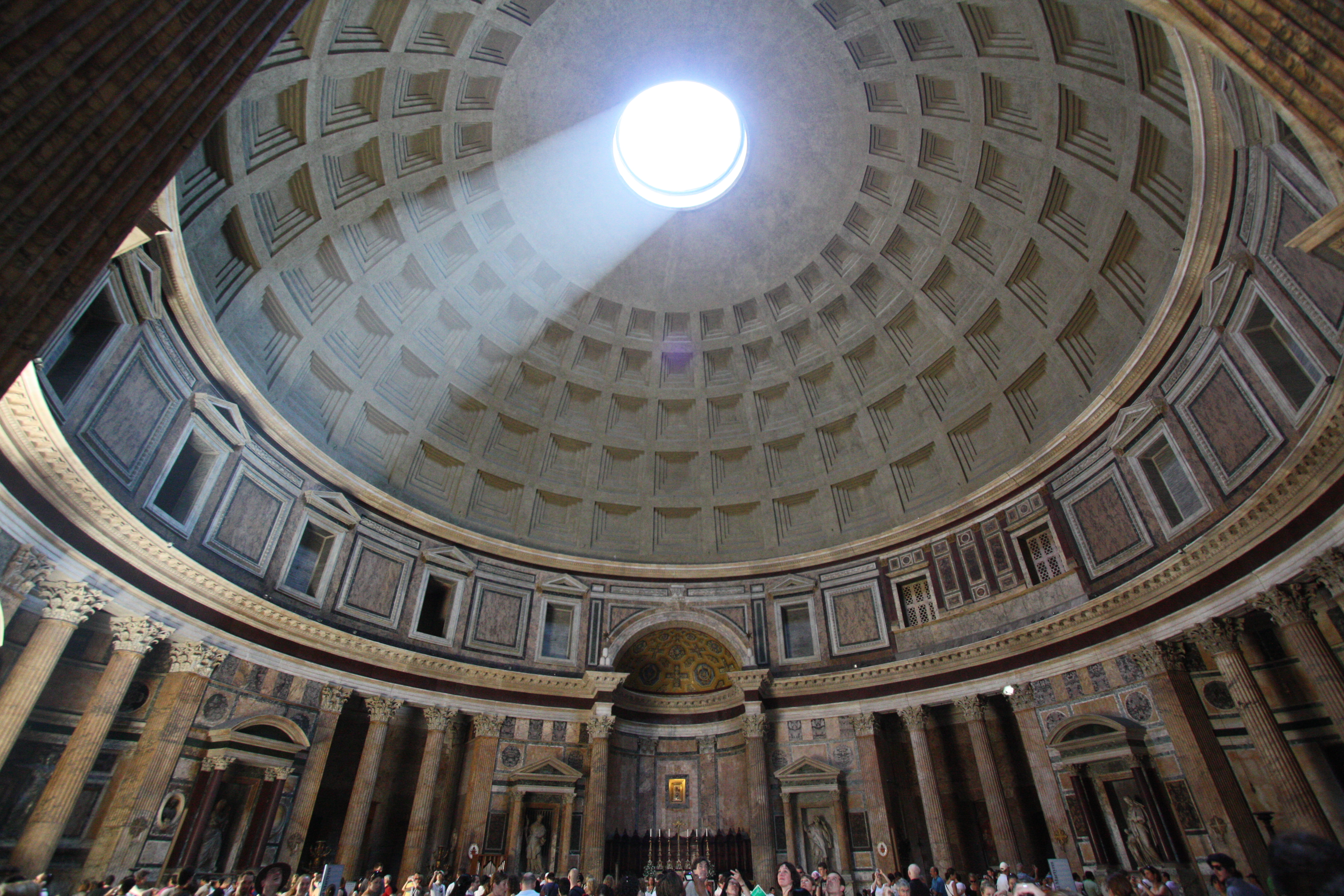
The Romans are most well known for the construction of magnificent buildings, such as the Colosseum above. The Romans discovered and began using the arch in architecture. Along with the arch came other opportunities for design, the barrel vault and dome. A barrel vault is an arch that is projected three-dimensionally. A dome is an arch that has been rotated around a single point.

Dome at the Pantheon in Rome 

Barrel Vault at the Basilica Nova, built in 312 A.D.

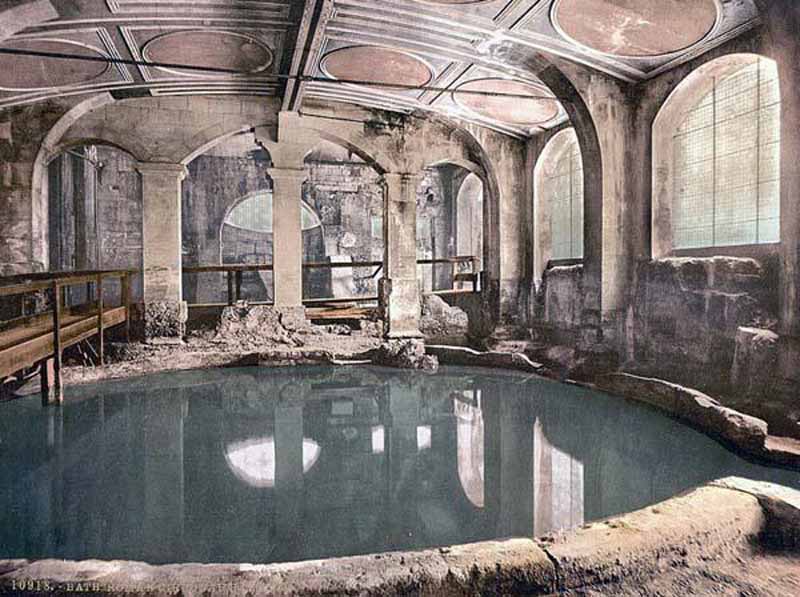
An aspect that Rome is not as well known for is the invention of concrete. Concrete has been used as a major building material since that time and many architects are very thankful for that invention. Romans were also well known for their public bath houses. "Bathing was one of the most common daily activities in Roman culture, and was practiced across a wide variety of social classes. Though many contemporary cultures see bathing as a very private activity conducted in the home, bathing in Rome was a communal activity. While the extremely wealthy could afford bathing facilities in their homes, bathing most commonly occurred in public facilities called thermae. In some ways, these resembled modern-day spas. The Romans raised bathing to a high art as they socialized in these communal baths. Courtship was conducted, as well as sealing business deals, as they built lavish baths on natural hot springs." (wikipedia)

Baths of Trajan
Roman baths at Villa Adriana, in Rome

Romans used much of the same type of furniture as the Greeks, including the klismos chair. However, they did have their own furniture inventions as well. The "cathedra" which was made a more heavy structure based on the basic design of the Greek klismos. They also developed the "sella" a type of stool, and they developed the first type of "fainting couch" a "lectus", which doubled as a couch for setting with guests and a bed at night. 

Sculpture of a cathedra

Roman sella 
Roman Lectus

The Roman people had many inventions pertaining to architecture and interior design and should be greatly appreciated for all of their accomplishments, many of which were ahead of their time. The idea of developing concrete and constructing unreinforced domes that weigh thousands of pounds, yet are still standing today is very impressive. 

Current Applications of Roman design:
Arches used as decorative interior in a current day home


Arches in a modern bathroom


A dome shaped home


The St. Louis Arch


Friday, January 30, 2015

Greek Design


The Greeks are best known for their innovative use of columns in architecture. They were the first people to really create and perfect the art of columns. What was so amazing about this was their ability to space them and differ the sizes of them in order to make them appear more perfect in the eye of the beholder. Many monuments, buildings, and temples that were erected by the Greek culture are still around today because they had such solid building techniques. 


The Greeks developed the first three orders of columns that are represented in architecture. The Doric, Ionic, and Corinthian. 

Doric: "Doric columns stood directly on the flat pavement (the stylobate) of a temple without a base; their vertical shafts were fluted with 20 parallel concave grooves; and they were topped by a smooth capital that flared from the column to meet a square abacus at the intersection with the horizontal beam (architrave) that they carried." (wikipedia)
Doric Column

Ionic: "The Ionic capital is characterized by the use of volutes. The Ionic columns normally stand on a base which separates the shaft of the column from the stylobate or platform; The cap is usually enriched with egg-and-dart." (wikipedia)


Corinthian: "stated to be the most ornate of the orders, characterized by slender fluted columns and elaborate capitals decorated with acanthus leaves and scrolls." (wikipedia)


Columns were a major contribution of Greek design because they are still used in many forms of architecture today, especially in government buildings. However, the Greeks created some lasting pieces of furniture as well. One of those being the klismos chair, it's defining characteristics including splayed legs and a curved back rail. This design is still used frequently today.


Current Day Applications of Greek Design:

Current design of klismos chair.

A home with columns.


This is a neat video about the Greek temples and their design elements. 
https://www.youtube.com/watch?v=F59pH4UJjz4


Sunday, January 25, 2015

Extra Credit Post

I was really intrigued by this time period and although I have heard about ancient Egypt throughout my schooling I did not know much about it other than the fact that they made the pyramids and used a lot of gold. So I decided to do a little extra searching and educate myself a bit more about this time period. I found some great examples that I wanted to share with everyone else; so if you are interested feel free to check out the links below!

The first is a great Prezi presentation that I found online about the Egyptian civilization as a whole.
https://prezi.com/-6bxhxwrcqbi/egyptian-civilization/

The second is a website called ancient Egypt online that shows photographs of some of the architecture, an overview of what hieroglyphs the Egyptians used, Gods that the Egyptian people worshiped and must more. It was a very interesting source of information.
http://www.ancientegyptonline.co.uk/index.html


Lastly, I wanted to know why Egyptians had foot-boards on their beds but not head-boards. So I did some searching around and found this; it turns out that beds were slanted down from the headrest area, so therefor foot-boards were actually used to prevent the individual from sliding right off of the bed in the middle of the night.
I found that information on this website and it had some great examples of furniture from the time.
http://www.touregypt.net/featurestories/furniture.htm

Blog Reflection: 1/25/15

   Nichole Kopsias: I felt that she had a very well rounded blog post with information that touched on many areas of Egyptian design history. I really liked how she had a link inside her text, by clicking on the word Giza, I was able to go to another website and learn more about it. That was a nice touch. The images that she used were interesting and as soon as I looked at them I was able to tell that they were of Egyptian influence, spot on for this time period. I also thought that the YouTube video was a great touch!

Paige S: She covered the facts, but it seemed slightly dry. Some more in depth discussion would have been nice. I thought that the image of the Great Hypostyle Hall was interesting and would like to know more about that location. I thought that the bathroom example of current day application was neat and well executed without being too over the top.


Saturday, January 24, 2015

Ancient Civilization: Egypt, Mesopotamia & Nubia


Around 4,000 BC larger towns began to develop in what is the Middle East of the present day. Humans basic needs were being met, without much resistance so they began to create complex inventions and the arts. A sense of camaraderie and competition came about between the three major civilizations of the time; Egypt, Mesopotamia and Nubia. They fed off of the creative energies of one another and each wanted to create something bigger and better than the others. Architecture became a way for these civilizations to do that, it was used to distinguish different classes of people and to show power and intimidate the viewer.

Temple of Luxor


Geographical location made Egypt an ideal place for the building of these ornate monuments and temples. The Nile River granted the people access to transportation of goods; including building materials such as precious timbers from other countries. The climate in this region made the preservation of these buildings slightly easier than those in other areas, because the mild dry temperatures is much better than extreme wet conditions. The climate also played a large part in how buildings were designed. Flat roofs, outdoor spaces, windows, and roof ventilators were included to keep the spaces airy and cooler. Since building materials in this region were limited, unless transported in from other places, many buildings were made of mud bricks or wood and stone walls. 


The interiors of Egyptian architecture were very ornate and decorative. The artisans of the time created fresco paintings, relief sculptures, inscriptions, mats or rugs, and very detailed pieces of furniture. They were actually the first believed inventors of furniture joinery that we still use today; mortise and tenon joints, dovetail joints, and dowels. 


Current Day Applications


Dovetail Joint
Mortise and Tenon Joint

Sunday, January 18, 2015

Peer Reviews 1/18

Paige Perry: Your post was very informative and well written. I really enjoyed your images, especially those of the modern day applications. They were great examples of post and lintel architecture, and the one of the sitting area was gorgeous. You really seem to have a great understanding of this time period and helped me to know more than I previously did.

Mackenzie Carpenter: I really like your examples of current applications of the prehistoric period. The home with the white stone interior was gorgeous and instantly made me think of the prehistoric period, it almost reminded me of the Flintstones. I also thought that your video was a nice addition and was very informative about the different cave paintings. The photo of the piece of furniture intrigues me, it is difficult to tell its exact size though, so I wonder if it is a piece of furniture or if it is a cooking pot or bowl of some type?